
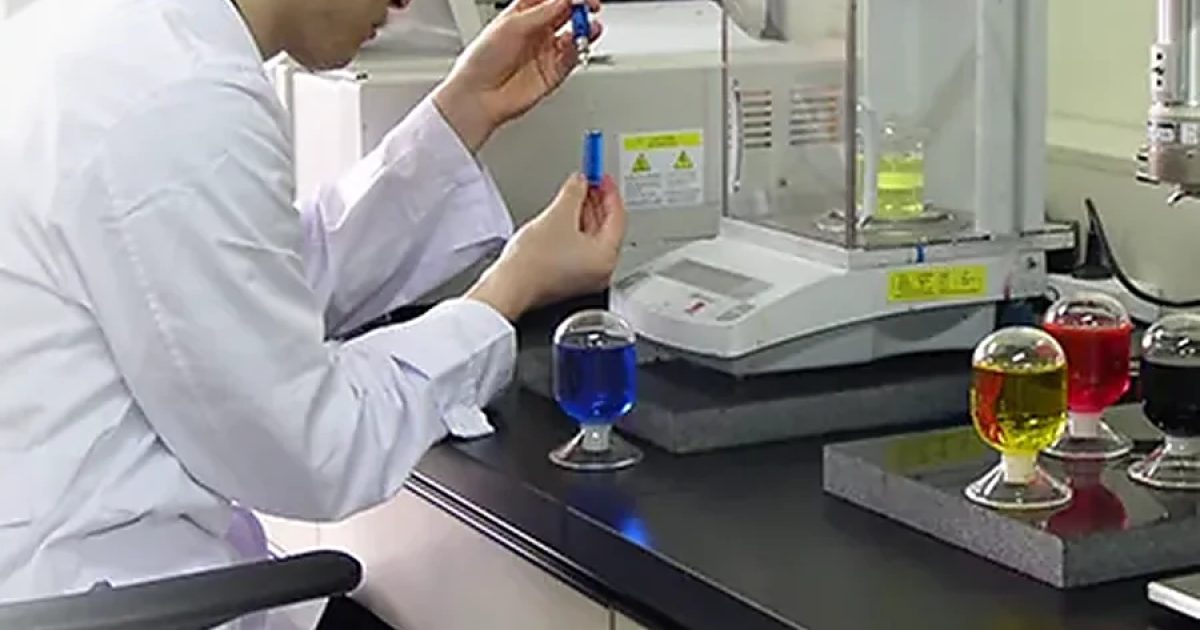
Inkjet inks are divided into pigment inks and dye inks according to the colorant that gives them their color. Pigment inks contain tiny, insoluble color particles evenly dispersed in the ink, while dye inks use colorants that dissolve in the ink. Prism Technology develops and produces both. This article sums up the differences worth knowing when choosing between them.
Pigment ink — particle size and dispersion decide performance
A stable nano-size dispersion is essential for particle stability and a wide color gamut. Yet a nano dispersion cannot be achieved by milling alone — it is state-of-the-art chemistry. When the average particle size and polydispersity index (PDI) are measured under the same conditions, smaller values and a narrower distribution mean less nozzle clogging and a more stable dispersion.
| Ink | Average particle size | PDI |
|---|---|---|
| Prism Technology pigment ink | 91.7 nm | 0.252 |
| Typical pigment ink | 143.1 nm | 0.452 |
Pure pigment ink vs modified pigment ink
Pigment inks can be made from pure pigments or from modified pigments. Prism Technology summarizes the technical differences as follows.
| Item | PRISM pure pigment ink | Typical pure pigment ink | Modified pigment ink |
|---|---|---|---|
| Particle size | 80–120 nm | 100–200 nm | 80–150 nm |
| Stability | 1 year or more | 3 months or less | 1 year or more |
| Strengths | Good color; resistant to water and light | Resistant to water and light | Good stability |
| Weaknesses | Requires a high level of technology | Nozzle clogging | Weaker color; less resistant to water and light |
Dye ink — purity decides color and shelf life
The storage stability and color gamut of a dye ink depend on the purity of the dye. Prism Technology synthesizes and purifies its inkjet dyes in-house, removing impurities and metal ions, and makes its inks from these high-purity dyes.
Which ink should you choose?
The basic rule is to choose ink that matches your printer and cartridge. The right ink depends on whether the OEM cartridge uses pigment or dye and on the printer model. Search our product pages by printer model or OEM cartridge number to see the matching ink and its type (pigment or dye).
Ink for a CISS
Ink inside a continuous ink supply system (CISS) is exposed to light and evaporation and can change. Light attacks the colorant, and evaporation changes the physical and chemical properties of the ink. Ink for a CISS therefore needs:
- Highly light-fast dyes at sufficient concentration
- High chemical stability
- Good fluidity in micro-channels
- Minimal residual bubbles in the ink
PRISM inks use sufficient ink concentration, a stable formulation and light-fast dyes and pigments, so they keep well and maintain their performance over long use.
Shelf life
| Condition | Period |
|---|---|
| Room temperature, sealed | 2 years |
| Room temperature, opened | 1–3 months |
| Inside a CISS | 3–6 months |
The storage temperature range is -15 °C to 60 °C. In a 3-day accelerated test alternating heating (70 °C) and cooling (-15 °C) — equivalent to 2 years of storage at room temperature — PRISM HP 9010 pigment and dye inks showed no change in quality.
Frequently asked questions
Q. Should I use pigment ink or dye ink?
Use the ink that matches your printer and OEM cartridge. Our product pages show the matching ink and its type by printer model or OEM cartridge number.
Q. What is the particle size of PRISM pigment ink?
Measured under the same conditions, the average particle size is 91.7 nm with a PDI of 0.252.
Q. How long can opened ink be stored?
1–3 months opened at room temperature, 2 years sealed, and 3–6 months inside a CISS. The storage temperature range is -15 °C to 60 °C.